CONSCIO UNDER PRESSURE
The Science of Staying Clear When Leadership Gets Hard
Why do intelligent leaders suddenly make decisions they later regret?
Why do capable founders snap in meetings, override good instincts, or push teams past the point of trust?
You don’t have a leadership skill problem.
You have an access problem.
Conscio Under Pressure reveals a hidden truth about leadership failure:
Most breakdowns don’t happen because leaders lack strategy, discipline, or experience. They happen because pressure distorts the biological state that intelligence depends on.
This book introduces a new paradigm for leadership:
Leadership is not just about strategy. It is about State Mastery.
Access before intelligence.
Regulation before decision.
Coherence before authority.
If you’ve ever looked back at a decision and thought:
“Why did I react like that?”
This book will show you what really happened.
And how to lead clearly when the stakes are highest.
Start the journey toward leadership clarity.
Get Conscio Under Pressure Now!



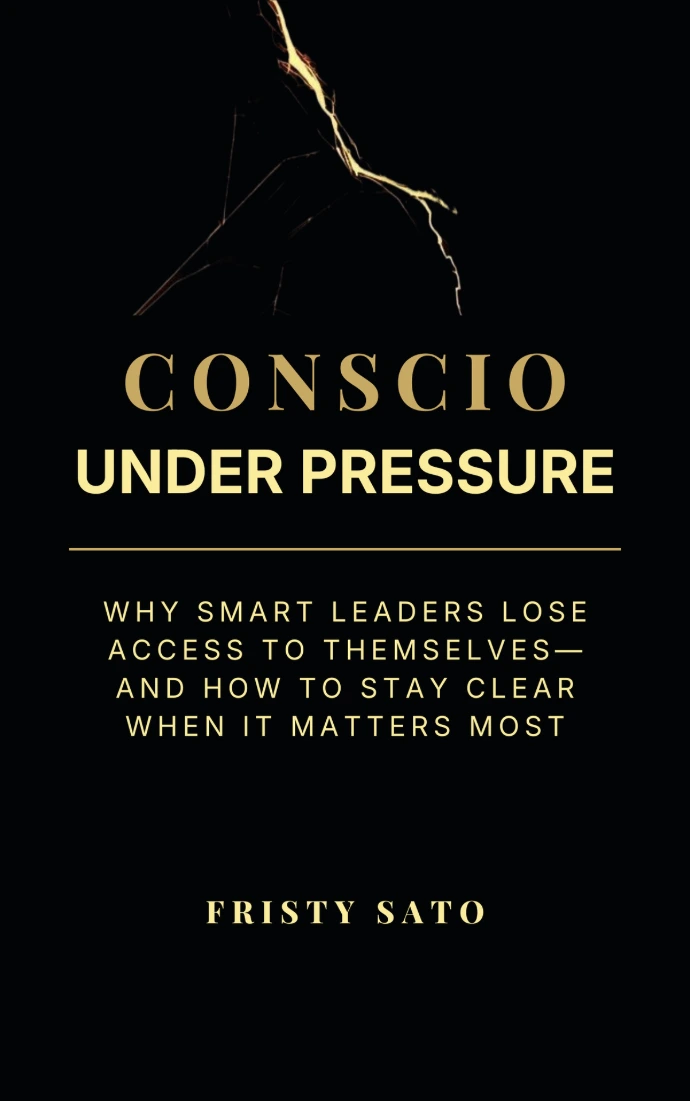
When pressure rises, the nervous system narrows perception. Intelligence doesn’t disappear — access to it does.

The Hidden Leadership Problem Nobody Trains You For
If you’ve ever left a high-stakes meeting thinking:
“That wasn’t the leader I want to be.”
You’re not alone.
Many leaders believe their biggest challenges are:
- strategy
- communication
- execution
But under pressure something else happens first.
Your nervous system shifts into survival mode.
Attention narrows.
Listening drops.
Confidence spikes.
Decisions become faster — and often worse.
This is what Conscio Under Pressure calls The Access Gap.
Your intelligence is still there.
But under pressure, your brain temporarily loses access to it.

Signs You May Be Experiencing the Access Gap
Many leaders quietly recognize these patterns:
- decisions made under pressure feel different afterward
- confidence increases during conflict but clarity drops
- team tensions escalate faster than expected
- authority feels forced rather than natural
- emotional residue lingers after difficult meetings
- speed replaces thoughtful discussion
These experiences are often interpreted as leadership weaknesses.
But in many cases they are simply state distortions under pressure.
When access returns, leadership clarity follows.
For Readers Exploring Leadership Under Pressure
Conscio Under Pressure sits at the intersection of:
- leadership psychology
- nervous system science
- decision making under stress
- startup leadership dynamics
It continues conversations explored by thinkers such as:
- Daniel Kahneman — Thinking, Fast and Slow
- Ronald Heifetz — Leadership on the Line
- Patrick Lencioni — The Advantage
- Amy Edmondson — The Fearless Organization
But Conscio Under Pressure takes the conversation further.
It focuses specifically on small leadership teams operating inside volatile environments — where pressure, speed, and responsibility collide daily.
Get Conscio Under Pressure Now!





Who This Book Is For
Conscio Under Pressure was written for leaders operating inside real volatility.
Especially:
- startup founders scaling small teams
- technical leaders suddenly responsible for people
- executives carrying intense decision pressure
- high-agency operators who feel their leadership narrowing under stress
If you have ever wondered:
“Why does leadership feel heavier than it used to?”
This book was written for that moment.
Get Conscio Under Pressure Now!

4 Core Pillars of Conscio Under Pressure
State vs. Skill: Your Performance Infrastructure
You cannot apply a leadership framework from a state of biological contraction. State Mastery is the missing layer of development—it ensures your executive functions stay online so your skills remain repeatable rather than costly.
The Stabilizing Anchor: Authority Without Force
The best leaders don't absorb chaos; they regulate it. By using the THRIVE Method™ to regulate faster than the environment can disrupt you, you maintain natural authority and a wide field of vision. This is how you lead through complexity without emotional residue.
The Access Gap: Intelligence Under Load
Smart leaders don’t lack skill; they lack Access. Under pressure, your nervous system triggers "survival cognition," narrowing your perception and forcing you to prioritize speed over accuracy. We teach you how to bridge this gap and stay intelligent when the stakes are highest.
Signal Consistency: The Architecture of Trust
Trust leaks through Signal Inconsistency. When your internal state is volatile, your team shifts from creativity to "compliance" to survive your stress signals. Mastering your state prevents irreversible trust erosion and builds structural safety.
From the Reactive Leader to the Coherent Leader
The THRIVE Method is the architecture for this transition. It moves you from a state of internal noise to a state of systemic alignment, ensuring you remain the most steady presence in the room.
Transform
Restore your baseline. Stabilize your nervous system so your intelligence stays online while the environment stays loud.
Harmonize
Clear the field. Neutralize team friction and passive-aggression so the collective energy shifts from defense to delivery.
Realize
Decide with clarity. Execute high-stakes choices from a state of integrated intelligence rather than impulsive urgency.
Illuminate
End the trust leak. Align your internal state with your external signals so your team experiences you as a consistent, reliable lead.
Visioning
Scale with flow. Expand your team’s velocity and output without increasing the stress or fragility of the system.
Embody
Lead through presence. Shift from "trying to manage" to being a leader whose natural coherence commands respect and following.


A Note from Fristy
I wrote Conscio Under Pressure after years of watching brilliant people—founders and leads who are literally building the future—suddenly lose their edge when the heat got turned up. It’s a painful pattern I’ve seen in countless high-stakes rooms: the smartest person in the room starts making the most incoherent decisions.
I realized it isn’t a lack of talent or "mindset" failing them; it’s just biology. Your nervous system is designed to contract under stress, and that contraction cuts off your access to the very intelligence you spent years building. I wanted to finally name this invisible layer so you can stop fighting your own physiology and start leading from a place of actual coherence again. I hope this helps you find your way back to yourself.

Frequently asked questions
Even highly intelligent leaders can make poor decisions when pressure activates the nervous system’s threat response.
When the brain perceives danger — whether financial, reputational, or social — it prioritizes speed over accuracy. This narrows attention and reduces access to the prefrontal cortex, the area responsible for strategic thinking and emotional regulation.
Conscio Under Pressure calls this The Access Gap.
Your intelligence hasn’t disappeared. Your system temporarily lost access to it.
Learning how to stabilize your leadership state allows decisions to come from clarity rather than urgency.
Sudden anger or defensiveness in meetings is often a sign of nervous system overload, not poor character.
When leaders feel judged, rushed, or responsible for too much risk, the brain interprets the situation as a threat. This activates fight-or-flight responses that can override reflective thinking.
The result can look like:
- interrupting teammates
- reacting defensively
- making rushed decisions
- escalating tension in the room
Conscio Under Pressure explains how leaders can recognize these state shifts early and restore access before reacting.
Staying calm under pressure is less about willpower and more about state regulation.
Leaders who remain clear during volatile moments tend to develop three abilities:
- recognizing when their nervous system is entering threat mode
- interrupting the escalation before reacting
- restoring cognitive access before making decisions
In the book, Fristy Sato introduces the 90-Second Reset, a practical tool for restoring clarity when stress spikes during leadership situations.
Leadership authority rarely disappears overnight.
More often, it erodes slowly through signal inconsistency.
When leaders become reactive under pressure, teams begin adapting to those signals. People become cautious, honest conversations decrease, and decision discussions become guarded.
This shift is not always visible to the leader.
Conscio Under Pressure explains how Pressure Coherence helps restore stable leadership signals so teams can trust decisions again.
Startup leadership combines several high-intensity stressors:
- constant uncertainty
- rapid decision cycles
- financial risk
- emotional responsibility for a small team
When leaders operate in prolonged threat states, their nervous system never receives a signal that the danger has passed.
Over time this can lead to decision fatigue, emotional reactivity, and leadership exhaustion.
Conscio Under Pressure introduces THRIVE, a framework for maintaining clarity and leadership capacity even during high volatility.
Freezing in important conversations is a natural nervous system response.
When the brain detects social threat — such as judgment, criticism, or authority pressure — it can trigger a freeze response. This response temporarily shuts down verbal fluency and strategic thinking.
Many leaders interpret this as a confidence problem.
In reality, it is a biological state shift.
Understanding how to restore access during these moments is one of the central ideas explored in Conscio Under Pressure.
Better decisions in fast environments require something counterintuitive:
brief moments of regulation before action.
When leaders interrupt reactive cycles, even briefly, the brain can reconnect analytical thinking with emotional awareness.
This creates what Conscio Under Pressure calls Decision Integrity — decisions made from integrated intelligence rather than urgency.
Over time this dramatically improves both team trust and strategic clarity.
Lead With Access Again
Leadership should not require sacrificing clarity.
It should not require losing yourself in pressure.
When the nervous system is stable, intelligence returns.
Teams stabilize.
Decisions become cleaner.
And authority no longer needs to be forced.
Begin the shift from reactive leadership to coherent leadership.
Get Conscio Under Pressure Now!